|
Another
common fault is the keyboard itself. If the synthesizer has
been in a dirty environment, key triggering can become a problem.
Poor key alignment and a "clonky action" are a sign
of a tired set of bushes. Repairing the keyboard itself is
very fiddly and is best left to a tech in my opinion, unless
you know what you are doing. Once it has been re-aligned and
new bushes fitted however, the keyboard action on a Polymoog
can be superb.
There
are also some things you can do to help your Polymoog out
where reliability is concerned. If you own a 203a, it's a
very good idea to replace the LED's and load resistors for
new ones. Modern LED's use much less power and you will be
giving the already hard pressed power supply unit (PSU) a
break. If your Polymoog has seen a lot of action you might
also be wise to replace the capacitors on the PSU as well.
This will help reduce the load and prevent ripple on the output.
If you're still confident and would like to take it a step
further, you can also consider replacing every Op Amp and
CMOS IC - they cost very little!
Possibly
the most comprehensive refit has been carried out by Kevin
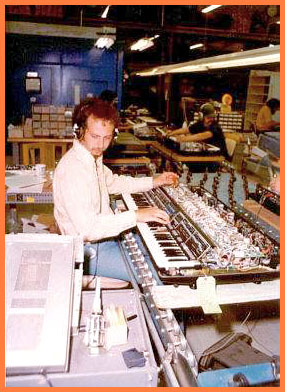
Lightner, (a top tech in the US). He has re-soldered all 4000 joints and replaced every capacitor
during a full rebuild but you will need deep pockets as the
amount of hours spent can be up to 3 weeks solid work!
These
faults are what you might expect to find on a second-hand
purchase or faulty Polymoog. I wouldn't consider these to
be everyday occurrences, because they are not. My studio Polymoog's
have remained fault free for 2 years now. I just wouldn't
recommend that you gig with the old lady these days, a studio
environment is far more dignified and should allow the Polymoog
to remain trouble free if it's kept cool, clean and not moved
with excessive force.
|