|
|
Variations
on a Theme
When
the model 203a Polymoog was released, for the first two years
of production it was know as the "Polymoog Keyboard".
In 1978, a new version of the Polymoog appeared. This was
designated the Model 280a and was know as the "Polymoog
Keyboard" and the 203a was now re-branded as the "Polymoog
Synthesizer". As if Luce's naming policy wasn't already
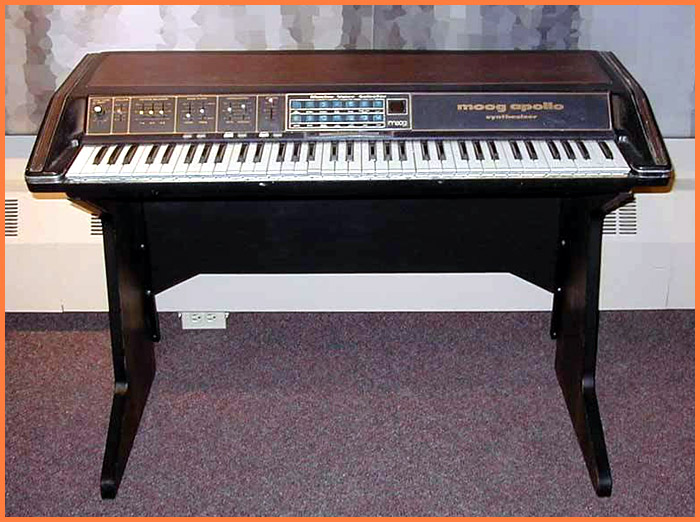
confusing enough, the prototype 280a had gone back to using
the "Apollo" name initially and from its physical
appearance, looked as though it may have been aimed at the
domestic "home organ" market!
|
|
|
|
|
|
|
|
|
|
|
Where
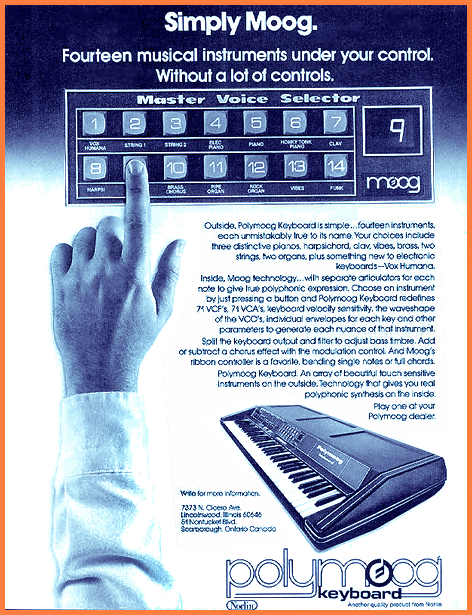
the new Polymoog Keyboard (280a) differed was that whilst
very similar internally, the 8 presets were now expanded to
14, (Vox Humana, String 1, String 2, Elec Piano, Piano, Honky
Tonk Piano, Clav, Harpsi, Brass, Brass Chorus, Pipe Organ,
Rock Organ, Vibes, and Funk).
The first obvious difference however, was that many
of the synthesizer controls had been stripped out, making
it essentially a "preset machine" with more limited
tweak-ability. With many of the synthesizer controls missing,
(the right hand section of the control panel now being completely
blank) what controllers remained were rudimentary main volume,
pitch adjustment over both VCO's using the beat function,
the pitch controller ribbon, volume for each of the three
keyboard sections, a high pass filter with control over level
and a range of 60 to 300Hz) adjustment, attack rate and controls
for the modulation amount and rate.
|
|
|
|
Where
the 280a differed from the 203a sonically was in the new preset
patches available. Each patch being hardwired with its own
circuit meant that although there was very definitely a core
sound common to both models, it was not possible to recreate
the new Vox Humana sound on a 203a, (due to the unique filter
configuration of each circuit). You might achieve something
vaguely similar, but it would never be able to match the distinctive
high pitched haunting wail of this very unique Vox Humana
sound.
It
has to be said that if it wasn't for the Vox Humana patch,
(immortalised by Gary Numan) the 280a would have very little
to offer. Rather like the original Mellotron or Roland VP330
Vocoder choir sounds or the TB-303 bassline, or CR-78 / TR-808
/ TR-909 drum machines, this is one of those unique and distinctive
sounds that is instantly identifiable and in the case of Vox
Humana, practically un-sampleable due to the complexity and
delicacy of the sound. It might be possible to create a passable
imitation with a huge multi-sampled set of each of the 71
notes at various velocities, (you would probably need at least
250-500Mb) but then you would be unable to recreate the pitch
ribbon controller or vary the modulation as you would with
the real thing.
|
|
|