|
Was it a true synthesizer and was it really polyphonic? The Polymoog used divide-down twin oscillator circuitry,
(with relative detune) which wasn't dissimilar to that employed
in string machines and electric organs. To some this meant
that it didn't have the "characteristic" Moog sound
and was somehow thinner and not the "real deal".
Once again, the derisory battle cries from those expecting
a polyphonic Minimoog. As previously mentioned, this wasn't
Luce's intention...
|
|
|
|
|
|
|
|
So
what was it capable of? Both
oscillators could be detuned against each other and the Polymoog
offered sawtooth and pulse/square waves, (although limited
to certain keyboard split zones). In addition pulse width
modulation was also available. Oscillator 1 was ramp only
and could be switched to 8' and 4' ranges and oscillator 2
was variable pulse and was switchable between to 16' and 8'
ranges. The oscillators could then be passed through what
Moog rather grandiosely referred to as "Resonators".
In fact it was really just a three band equaliser but with
variable gain, frequency and resonance (similar to a parametric).
The Polymoog also had a 5 channel mixer on the control panel
for the direct output of the preset, filter, resonators and
the lower and upper halves of the keyboard - providing facilities
to layer each section of the sound. In addition, each section
had a separate output for external processing. The Polymoog
had ample output options; Trigger outputs controlled external
monosynth's and there were three inputs that allowed you to
pass an external sound source through the Resonators and the
VCF.
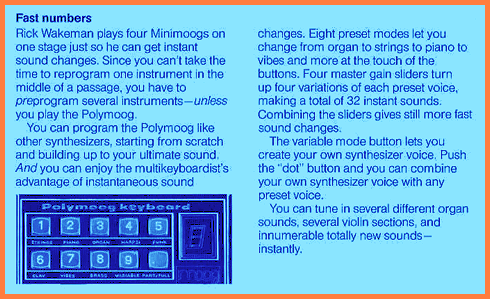
So what about the "presets"? Once again this was a misconception. Luce claimed
that the Modes, (remember - he didn't call them presets) were
supposed to be a "starting point". For instance
if Piano was selected, this would be set up to offer the correct
percussive envelope and tone of a piano sound but then the
operator was supposed to then use the VAR mode to modify the
sound to taste with the synth section. What made the Modes
different from simple presets derived from the front panel
controls was that each mode was generated by dedicated chips
containing 142 circuits known as articulators.
|
|
|
|
|
|
|
|
|
|
|
|
|
|
|
The articulators consisted of 71 amplifiers and 71 filters that shaped
the sound from the oscillators. In effect the articulators
contained the fundamental timbre of each sound. This clearly
explains why some of the new "presets" available
on the 280a Polymoog Keyboard were difficult or impossible
to reproduce on
|
|

|
|
|
|
|
|
|
the
original 203a, simply because the dedicated articulator circuits
were not available in the 203a.
As
I mentioned earlier, Polymoog's had a Moog ladder filter but
there was only the one so this part was technically monophonic.
The filter did offer a dedicated ADSR, variable cut off, resonance.
In addition, it also provided two modulation sources, (LFO
and Sample and Hold). There was also a separate velocity sensitive
VCA and envelope for each note so it was polyphonic, well,
kind of…
|
|
|
|
Depending on the trigger option selected, when sustaining
a chord and then playing an additional note, the new note
would either trigger all of the other notes being held, or
would have no filter articulation. If it was played using
the "Mode" output and the controls were left in
their "Pre" states, you could actually play it in
true polyphonic fashion. In practice though, you would almost
certainly use the final VCA, VCF and Resonators, which would
produce what would be more accurately described as "Paraphonic".
I believe this is because compromises had to be made. As if
the Polymoog wasn't already expensive, bulky and complicated
enough… to add a separate filter and envelope for all 71 notes
would have been unviable, not to mention an immense physical
challenge. Corners invariably had to be cut and rather than
offer limited polyphony found in the 4, 6 and 8 voice polysynth's
that were just around the corner, Luce decided to use the
divide-down dual oscillator method to achieve his objectives...
the worlds first fully polyphonic synthesizer. Whether
|
|
|
|
|
|
|
|
|
|
|
|
he accomplished this or not is a matter of divided opinion but... yes!
all 71 notes on the Polymoog can play simultaneously, something
which is still rare even now, 30 years later.
|
|

|
|
|
|
|
|
|
|
|
|
|
|
|
|




